
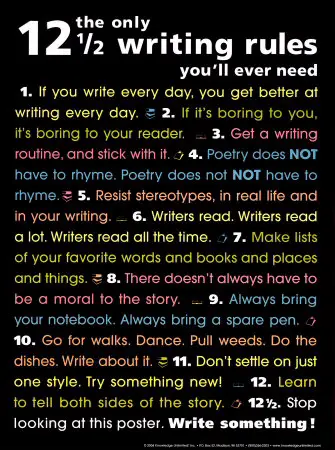
This is one of my favorite posters. It hangs where I can see it from my desk:
12 and ½ Writing Rules from AllPosters.com.
Everything on there is good advice for any writer, especially those working on pieces of fiction. It also looks great on the wall of your office or den – it’s currently replacing my rather battered poster of Johnny Depp…
So what exactly do these rules mean, and how can you use them to make you a better writer? This is my take on it – I expect everyone who owns this poster has a slightly different opinion!
1. If you write every day, you get better at writing every day.
This is common – and good – advice that lots of published authors offer. Stephen King, for instance, suggests that aspiring writers should write a minimum of 1,000 words a day. Many people, myself included, find that it’s easier to make something a daily habit rather than a “not quite daily” habit: I’ve written about this one in How to Write Every Day (And Why You Should)
2. If it’s boring to you, it’s boring to your reader
When I was doing NaNoWriMo last year, I found myself churning out sentences, paragraphs and scenes just to hit my wordcount for the day – what I was writing didn’t always interest me much. If you find yourself struggling to write because you’re bored, stop! No-one’s going to want to read it.
This goes for bloggers too. I was having difficulties writing articles during the pre-launch stage for my new blog, Alpha Student. The posts I was attempting were the same sort of advice that students read everywhere. I realized that if it was boring me, it wouldn’t be much fun for potential readers – so I rewrote all the pieces I’d produced, putting much more “heart” into them and writing from personal experience.
3. Get a writing routine and stick with it
For me, this rule goes hand-in-hand with writing every day. If I’m not in a routine, it’s hard to fit writing in. When I worked full-time, I woke up early every morning to write before work – then wrote until dinner-time in the evening. That was the routine that worked for me.
It doesn’t matter what time of day you write, or where you write – but you’ll probably find it easiest to knuckle down and get on with writing when you’re consistent about it.
4. Poetry does NOT have to rhyme. Poetry does not NOT have to rhyme.
I’m not a poet (yet – my Creative Writing MA is going to involve producing some poetry!) so for me, this rule is about not having preconceptions about what’s “right”. A blog post can be four thousand words long if you want: just look at Steve Pavlina’s success. A short story can be six words: Hemingway’s “For sale: baby shoes, never worn.”
If you are a poet, John Hewitt over at PoeWar ran a great series in September on 30 Poems in 30 Days – he goes through lots of different forms for poems, and offers tips on poetry submissions, competitions and much more.
5. Resist stereotypes, in real life and in your writing.
As a writer, whether of fiction or non fiction, you need to be alert to learning new things and meeting new people. That means avoiding stereotypes that block you from being open to the world.
And in your writing, be careful not to stereotype. Flat, boring characters are ones where the author has been lazy: the beautiful, dim blonde, the teenage thug, the computer nerd. Twist the stereotypes around and create characters who are real, full, human beings.
6. Writers read. Writers read a lot. Writers read all the time.
Stephen King suggests that writers should read for four to six hours a day. While that’s probably impractical for most of us, it’s still hugely important for writers to read. I’m always shocked when a fellow writer confesses that they don’t read, or claims not to have time to read.
If you write novels, you need to know what other authors in your genre are doing (read the classics too – there’s a reason they’ve endured so long). If you write blog posts, you should be aware of what other bloggers are working on. And if you’re a freelance writer, you can use examples of exceptional writing to inspire you and help you improve your own ability.
7. Make lists of your favorite words and books and places and things.
My younger brother used to collect unusual pub names in a book; a list like this could be a great resource for a fantasy or comedy author. I like to jot down words that I particularly like in the back of my notebook – “sinuous” and “eclectic” are two of my favorites; I love the way they sound and the way they look on the page.
Making a list is also a great way to spark off ideas, and combining elements from two separate lists can often be a good prompt for a piece of fiction.
8. There doesn’t always have to be a moral to the story.
This rule is slightly unsettling for me, as I like my fiction to have a strong theme. I think, though, it means that we shouldn’t try to ram a moral down readers’ throats. Tony Price, the vicar at my childhood church, is a wonderful storyteller, and often uses stories in place of a sermon – especially at Christmas, Easter or Family services. He talks about “trusting the story” – leaving people to take their own meaning from it, rather than telling them what it’s supposed to mean.
Trust your stories. And trust your readers to draw their own conclusions about good and evil, right and wrong – without you making your own views explicit.
9. Always bring your notebook. Always bring a spare pen.
This is another piece of advice that I’m sure all aspiring writers will have heard time and time again from the professionals: carry a notebook everywhere. Ideas come at odd moments (I get a lot of mine whilst walking) – and ideas vanish just as easily. Get in the habit of keeping a writers’ notebook to record your thoughts.
10. Go for walks. Dance. Pull weeds. Do the dishes. Write about it.
You don’t need to take this rule literally. It means that you should write about the everyday things, the normal things, the little details that make life real. It also means you should write about your own experiences. Good fiction is often about normal life, acutely observed.
(Just keep the “If it’s boring to you” rule in mind…)
11. Don’t settle on just one style. Try something new!
If you’re convinced that you’re destined to write great literary fiction, you might never find out that you have a talent for light-hearted columns. If you think you can only write novels, you might never win a short story competition with a sharp twist-in-the-tale piece.
Don’t convince yourself that you can only write in one particular style or genre: keep experimenting. I was certain that I wanted to be a fiction writer before I began blogging – and realized how much I love writing non-fiction too. (And I’ve found I can write blog posts in a factual style, a personal style, even a humorous style.)
12. Learn to tell both sides of the story
Have you ever read a story where the good guys were perfect and the bad guys were despicable? Unless you were a kid at the time, it probably bored you. There’s two sides to every story, and very few people are “evil” just because they want to be. Make your villains dark grey, not black, and give their point of view too.
If you’re writing non-fiction, try giving the “for” and “against” of a topic – even if you yourself come down firmly on one side. Darren Rowse on Problogger did this with Why Should You Join a Blog Network? and Why You Shouldn’t Join a Blog Network.
12 ½. Stop looking at this poster. Write something!
You can read writing advice all day – believe me, I have – but in the end, you have to sit down and put those words onto paper.
(If you have trouble with this, try the I Should be Writing podcast for regular inspiration and encouragement.)
Which of these rules work well for you? Do you have any of your own to add to the list?
Written by Ali, who runs the blog Alpha Student: helping students get the most out of university.
GET THE BOOK BY
ERIN FALCONER!


Your advice is very helpful. I have followed some of the rules above and have seen great improvement in writing. Thanks
Oh really, you have created a very good post and this post is useful for writers and students. From this, Everyone learns a good step about writing. Thanks for this post-Gustavo Woltmann
I think this is a real great blog. Really thank you! Want more.
Hi,
I’m a content writer and know about the writing skills very deeply. I’m writing content for blogs and websites for a long time. Most of the popular websites must have my content published on them. I want to suggest students to hire any professional writer to do their college essay work because you can learn many new things from their writing.
830522 993282I recognize there exists a fantastic deal of spam on this blog internet site. Do you want help cleaning them up? I can support among courses! 377182
Hi friend, thank you so much for this help and I would like to appreciate you for this help. But for now, I needed some ideas to find the best essay shark review for my work and I didn’t find that yet. Please help me with this.
544683 128823The vacation trades offered are evaluated a variety of inside the chosen and just good value all about the world. Those hostels are normally based towards households which you will find accented by way of charming shores promoting crystal-clear fishing holes, concurrent of ones Ocean. Hotels Discounts 46618
838382 912741This sort of wanting to come to a difference in her or his lifestyle, initial usually Los angeles Excess weight weightloss scheme can be a large running in as it reached that strive. weight loss 465625
have a sex
140340 955683I will right away grasp your rss as I can not in finding your e-mail subscription hyperlink or e-newsletter service. Do youve any? Kindly permit me realize so that I could subscribe. Thanks. 480753
これらのセクシーでリアルなラブドールは、すでに本物の人間のように見え、感じており、将来さらに進歩するでしょう。 AIのダッチワイフには至っていませんが、リアルなダッチワイフを所有することには多くの利点があります。 ラブドール https://yourdoll.jp
We are all needing such thing to get the roblox.
this is good post. here I know about technology. how we can use theme to increase our life good. so how long does it take to develop an application The development time to build a mobile app can range from 4 to 6 months and depends on app complexity.
에볼루션코리아
982CSTwvl}&\
에볼루션카지노
918UFboEZ`(%
에볼루션바카라
743uQPlsR\|`
에볼루션룰렛
814FcBuMK^-`
에볼루션블랙잭864ZVczQB+;~
The best e-cigarette liquid site in Korea. Korea’s lowest-priced 전자담배 액상 사이트 e-cigarette liquid.
스모크밤899 스모크밤
전자담배 액상 사이트 The best e-cigarette liquid site in Korea. smok25 Korea’s lowest-priced e-cigarette liquid. 스모크밤631 스모크밤
에볼루션카지노
068FXAyHW*#&
에볼루션카지노
933DbFVBX{|:
제주셔츠룸
569FNrhfO’;+
제주레깅스룸
378kmMsRi?$}
제주셔츠룸
351PKyRxH.<[
제주레깅스룸
673vgLSyd*/`
제주룸싸롱
793xurpFv~|-
꽁머니
524KnkLpI![`
첫가입꽁머니
793AAweSW/!.
가입시꽁머니
318oDyebT+]*
에볼루션카지노
324KFLHQF-,`
에볼루션카지노
175mTRijg:~’
Pingback: Quotes To Inspire Creative Writing - My Quotes
Prior to reading your piece, I was unaware of these regulations.
Thank you for contributing to the collective knowledge and providing such an enlightening article.
You can have the best time of your life with this product if you utilize it!
One of the most remarkable item ever created!
The cars are absolute beasts, each one more creative and terrifying than the last. Racing through explosions and chaos has never felt this intense survival race.
I like that these rules focus less on trying to make writing perfect and more on developing a consistent practice. The point about reading a lot especially makes sense, because writers can learn so much from seeing how different authors handle characters, structure, style, and ideas. I also agree with the advice about not forcing a moral onto every story. Sometimes leaving room for https://playgamebol.com readers to form their own interpretation makes a piece much more interesting. And the final rule is probably the easiest one to forget: at some point, you have to stop reading advice and actually write. For me, keeping a notebook for random ideas would probably be one of the most useful habits from this list.
Good writing is not always about following every rule rigidly, because tone, purpose, and the intended reader can change what works best. I like the https://baldibasicsplus.com idea of treating writing principles as useful guidance while still leaving room for an individual voice and style.