

Photos by Idea-man and TeeRish.
We read about it in magazines, blogs and news stories. Every day in the media we see it. What am I talking about? Passion. Passion for a cause, a product, a candidate or a company. You can easily read yet another story of a team that put in a Herculean effort to get their product out the door, their company launched or make that last deadline.
Even though they’ve spent large amounts of time at work, they look happy, satisfied, and only a little tired. For all the hours they spent at work, they certainly don’t have any of the signs that they’ve settled. What is it that drives groups like this and is there anything you can do to create the same passion in yourself and the people around you? At what point does being at work stop being work and turn into something enjoyable and satisfying?
Instilling passion in a group or team is an art practiced by many successful leaders and is something that can be learned – believe me, I’ve tried the suggestions below and have had great success. Many of us manage teams of people during our day jobs, and with the right team and working environment this can be an enjoyable experience. You may be leading a software development team, creating a product or working on a political campaign. Either way, you’re expected to motivate and lead a team through what may be, a period of very hard work.
Mo-ti-va-tion noun. The psychological feature that arouses an organism to action toward a desired goal;
While the textbook definition may be true, it certainly isn’t very, lets say, motivating. Motivation is the act of creating passion and passion is the fuel for great teams. Great teams feed on passion and leaders know how to nurture and instill passion in their people. We’re all trying to develop passion for our dreams, goals and desires and to motivate ourselves to take action. The following list is a few things I’ve learned and used to motivate my teams. I believe these lessons can be applied to our personal lives too.
Paint a vision of the future
Your goal as a leader is to develop a compelling vision for the team. Something that’s simple, yet elegant, maybe even a little edgy. Don’t bother with some stuffy board room mantra. If you do, you might as well hang it up before you get started. By simple, I mean something that creates the most impact with minimal effort. On a personal level – what is your vision of the future? Do you even have a vision? Unfortunately there is no ‘seeing eye dog’ that can help you develop your personal vision. Take time, dig deep and develop the vision of your future.
There is always more to the story
This is absolutely THE best leadership lesson that I’ve ever learned. In every situation that arises at work (and at home too), things are never as they seem. You may notice someone coming in late and leaving early and start to think – what a slacker. You may even complain about this person. Then you come to find out they’re taking care of an aging parent and make-up the hours every evening. You never know.
Break a rule for the team
I really like this tip and have used this successfully on various projects. I happen to work for an large “old school” computer company that had a strict dress code. At the time I was leading a team on a project that impacted everyone in our organization and it was important that my team was passionate about their work. I decided to purchase black denim shirts with the project name embroidered on the front (I know it’s no big deal now, but at THAT time, in my company, it WAS a big deal). NO one was allowed to wear denim in our office. But, I bought them anyway and I took a little heat from my manager. But in the end everything worked out. The team loved the shirts, was motivated, and put in the effort to get the job done on time.
Breaking a dress code rule is always a great thing to do for a team. Telling someone what to wear is the ultimate form of control and everyone is reminded of what their parents wanted them to wear when then were teenagers. Take one for the team, and they’ll take one for you when the time comes.
Really great teams feel as if they’re on a mission
You want your team to feel like they’re on a ‘mission from God’. The most successful teams have that type of passion and drive. The original Macintosh team had it, teams at Microsoft, Netscape and now Google have that drive. Do you feel you’re on a mission to achieve your personal goals?
Overcome an enemy
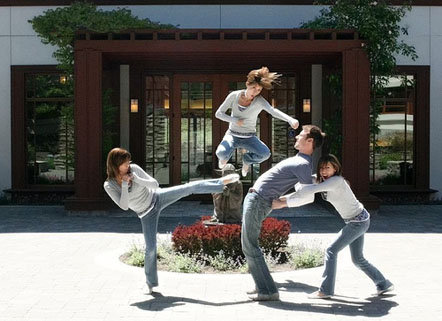
Every team needs an enemy to overcome. An enemy needs to be overcome in order for the team to be successful. Along with the leader’s vision, the drive to overcome an enemy will motivate the team to excellence. If there is no clear enemy, then you need to create one.
Have fun, no matter what
There’s enough pressure as it is at work, that you don’t need to be an ogre in the office to get your team to work. A team that is having fun will support the cause and will work hard.
Know and listen to your team
I’m not saying that every decision needs to be democratic, but you need to listen to team. When people are listened to and know their opinion is valued, they will work all the harder when the time comes. People need to be free to perform their absolute best. Great leaders surround themselves with great people and then get out of the way.
Sensible and flexible
As a leader you have to understand people have lives outside of work, and lets face it – things happen. Kids get sick, the car breaks down or your toilet erupts like Mt. St. Helens. Showing understanding and flexibility will pay huge dividends when the time comes.
This also means using failure as a learning experience. Your team needs to feel they can take a chance and not be punished. Like a dog that’s been hit one to many times, they’ll take the safe path and never develop that industry-changing-we-rock product that you’re looking for.
It’s been 24 years since I entered the professional workforce and I’ve experience both great leaders and some really bad ones. A few years ago I was asked to help a project that was “in trouble” and not going very well. I confidently walked into the office and what I saw was a sad sight. Before me was a room of people with a dead pan look on their faces, furiously coding at their terminals. No fun. No passion. No lets-save-the-world attitude. I tried to stir them from their stupor, but then I realized the problem. The team leader had sucked the life out of these people with his lack of leadership and constant badgering. After a year, he almost had me broken, too. But fortunately I escaped in the nick of time and he is no longer employed at our company.
When looking at new opportunities or projects to join, I use the tips above to evaluate the leader and to get a read on the team dynamics. A few simple questions and quick conversations can yield a lot of information about a leader’s style and the psyche of the team.
GET THE BOOK BY
ERIN FALCONER!



Thanks for the post.Thanks Again. Great!.
Right now it looks like Drupal is the preferred blogging platform available right now.
(from what I’ve read) Is that what you are using
on your blog?
Thanks for the post
May I simply just say what a comfort to uncover somebody who genuinely knows what they’re discussing on the net. You certainly realize how to bring a problem to light and make it important. More and more people really need to check this out and understand this side of the story. I was surprised that you aren’t more popular given that you most certainly have the gift.
ダッチワイフが生命のないロボット彫刻であった時代はもう過ぎ去り、それを使うのも面白くありませんでした。 しかし、時間と技術によって状況は変化し、今では男性に本物の女の子の感覚を与える超リアルなダッチワイフを手に入れることができます。 等身大ドール
MCZ33199EF is available. We are distributor of NXP Semiconductors / Freescale MCZ33199EF. Buy MCZ33199EF IC SERIAL LINK DVR AUTO 14-SOIC.
에볼루션코리아
901rYJhPB_/^
에볼루션바카라
865KlRUvE+[,
에볼루션룰렛
045iViVrO..)
에볼루션블랙잭297jcAEDC’^.
The best e-cigarette liquid site in Korea. Korea’s lowest-priced 전자담배 액상 사이트 e-cigarette liquid.
스모크밤489 스모크밤
에볼루션카지노
485QpHbUp!|~
에볼루션카지노
652SeuOrh>{|
에볼루션카지노
381GTXvks\.^
강남카빠
069EnjdRK;#=
Servis offers its customers the best quality Slippers online in Pakistan. You can buy slippers online in across Pakistan at great prices. So, grab your slipper today.
Sifa provides wide range of Pakistani party wear dress, which is making your outfit gorgeous and delightful. Grab your favorite party wears dresses online in all over Pakistan at low prices with fast delivery.
Discover the latest ladies dress design for women online at Jazmin. Grab your latest design in all over Pakistan at reasonable prices.
The material presented is quite intriguing, and I frequently watch these for further information before playing run 3 for fun.
Thanks for the valuable information and insights
Hello!
Discover our unique collection of mehndi flower jewellery and accessories. Our range includes beautiful earrings, bracelets, and more. All are made with intricate traditional craftsmanship, using the finest materials
This article is very good and easy to understand. I really like it.
Your blog is a delightful read! The positivity and joy it brings are truly heartwarming. graduation calculator by birthday Keep up the fantastic work!
Currently, downloading videos from TikTok without a watermark is a violation of TikTok’s usage policy, nytimes crossword as the content on TikTok belongs to the user who created it and is not allowed to be distributed or reused without the author’s consent.
For all your house as well as household needs!
Stylish style vlone are ready for you in our store, you should come to our cheap Vlone Clothing online store as soon as possible, you will fall in love with our cheap goods now.
Hurry up to come to vlone online store, a best shoulder to rely on in our online store.
Elevate your style with the latest Pakistani luxury formals. Our luxury formal wear is designed to make you feel like a true fashion icon. Don’t miss out on a chance to make a statement with our stunning collection. Find your favorite dress online today!
Thank you for inspiring me
If you want to change your look in winter then you should try this Diddi Moda Bowknot Leather Jacket because its rates are also reasonable and it is also good to look at.
I want to extend my heartfelt thanks for the insightful and thought-provoking content you shared. Your willingness to share your experiences and insights has greatly contributed to fostering a more informed and engaging discussion within our community
Pilih Letari Studio sebagai mitra dokumentasi pernikahan Anda, dan berikan sentuhan keindahan abadi pada momen bersejarah dalam hidup Anda. Letari Studio
I would want to express my sincere gratitude for the enlightening and stimulating information you provided. build now gg
Inspired by the creator Scott Cawthon’s childhood fears, Fnaf has transcended the boundaries of a traditional video game and become a pop culture icon. Delving into the dark recesses of your mind, this indie horror sensation continues to be a terrifying and unforgettable experience, proving that sometimes the scariest things are the ones we least expect.
Send love vibes with charming good morning messages for boyfriend. Ignite his day with affectionate words and make each morning special.
Thanks for sharing this informative and knowledgeable post.
I love how nikah dress trends are evolving while still keeping that timeless elegance!
Barat dress for bridal styles from renowned designers are showstoppers.
Speed Stars is absolutely perfect for people who love shaving milliseconds off their best time. Every run feels like a new personal record waiting to happen.
The game wacky flip brings players a flipping challenge that test their skills.
mr flip game is a physics-based 3D arcade game where you control Mr. Flip, a rag doll character, performs somersaults and lands perfectly on target areas.