

Image courtesy of Hamed Masoumi
Everywhere on and off the web, people talk about the benefits of planning. Plans help you define your goals, help you determine what tasks are needed and when you need to do them. And plans help you stay on track when distractions set in. So, what’s not to love about plans?
Lots.
When you overplan, you live in the future instead of the present, plan instead of do, and lose adaptability. All three of these mean you lessen your chances of reaching your goals. Instead you fumble around in the plan, wondering why despite all the hard work you’re doing, your business isn’t growing, your house renovations aren’t going anywhere, you aren’t losing weight, or you’re not reaching whatever goal you’re pursuing.
Fortunately the solution is easy.
- Create a mental sketch of the future you want.
- Work backwards to get where you are now.
- Go step by step forwards again noting down the crucial steps.
- Start implementing the plan, and
- Let the details fill themselves in as you get to them.
On his blog 6weeks.ca Brett Legree has a great take on the 80/20 rule. Eighty percent of our actions are unnecessary detail he says. If you can figure out the 20{54c12dad2cc2b53ae830e39915b1a3e70288dbcbbeb8bbf8395437c5dc3c512c} that’s mission critical, then your plan becomes easy to fulfill.
But before we go into too much detail about the solution, let’s look at the problems of overplanning in more detail.
Living in the future
Often when we’re planning something, we’re told by others to picture the outcome, create the success in your head. Get to know what it feels like, looks like. Figure out what is going on in your life around the success.
For me, that totally doesn’t work. I have an overactive imagination. If I dream of a positive outcome, I also come up with the complete failure. In both cases I end up experiencing all the emotions, all the highs and all the lows. And I get there without doing any of the work.
So, if I’ve already felt all the emotions associated with failing at or achieving a goal, why would I then want to do the work to get there? Nope. I’ll just stick to visioning, thank you very much.
Planning instead of doing
In my first business, as a Professional Organizer, I spent most of my time working on my business instead of in it. I would come up with marketing ideas, and new programs. I’d spend hours developing the best way to reach people, but then never implement it.
I spent thousands of dollars planning a business that I then spent little time working in. Oh, I had clients, and my reputation and recognition factor were good, but the real work of building a business contact by contact? That was too much work. I preferred to tweak my plan and get it perfect before actually doing anything about it.
However, a plan is never perfect. As soon as you act on it, something will change – because as much as you would like to, you can’t control the actions and reactions of others. A plan needs to be a flexible document, but it also needs to an incomplete document.
The moment you try to make the perfect plan, you trap yourself into a habit of forever updating the plan instead of doing something about it.
And that is simply procrastinating. So, stop it. And start doing.
Losing adaptability
When you rely too much on a heavily detailed plan, you can’t react to changes in the moment. If you’re stuck in a perfectionist phase (see above), then you’ll look at the changes and go update the myriad of details that the changes have affected.
And as I’ve said if you’re planning, you’re not doing.
For every detail you add to your plan, you add rigidity. A plan needs to be flexible; you need to be able to adapt it quickly to whatever changes come your way.
And you can’t do that if adapting means taking three days to plan out a whole new set of details.
The solution to overplanning
So, how can we save ourselves from overplanning? Where’s the dividing line between being thorough and using the plan to procrastinate?
Let’s look at the five step solution and see what each point means:
1. Create a mental sketch of the future you want.
The emphasis here is on “sketch” – you don’t want a detailed outcome. The sketch can be as simple as answering these three questions:
- What do you want by when?
- Why do you want it?
- What will you achieve by reaching your goal?
And stop. Don’t spend time creating the perfect image. Life can never match up (either positively or negatively) to what we can imagine, so why stress yourself by creating an unrealistic outcome?
2. Work backwards to get where you are now.
I don’t know why, but for me mazes are always easier if I start at the end and work backwards. A plan is the same way. Look for the shortest path from where you want to be to where you are now.
In business, this is called reverse engineering the outcome, which means taking a completed product and figuring out how it works based only on the outcome.
If you do this, you’ll cut out a lot of that 80{54c12dad2cc2b53ae830e39915b1a3e70288dbcbbeb8bbf8395437c5dc3c512c} of unnecessary actions that Brett talks about in his post.
3. Go step by step forwards again noting down the crucial steps.
Now that you know the shortest route to your goal, move forward again making note of the milestones you need to pass along the way. You don’t want to look at every single blade of grass along the path, but you do want to note the major landmarks that will help keep you on track.
4. Start implementing the plan.
This seems like the easiest step of the plan – do it! But for many of us, it’s actually the most difficult. We’re plagued by questions: “What if I didn’t plan for all the variables? What if I do a whole bunch of work and I don’t succeed? Why did I even want to achieve this stupid goal in the first place?”
Fear and inertia are powerful demotivators. To move from planning to doing requires commitment and courage. If you find it too difficult to get started on your own, enlist the help of someone else – like a coach or mentor, who can provide you with tools that will get you moving and who will make you accountable for progress.
5. Let the details fill themselves in as you get to them.
As you move towards achieving the first crucial step on your plan, ask yourself: “How will I get there?” Everyone is different, so let your intuition guide you. If you are passionate about your goal, the individual steps will appear. It all depends on what tools and what actions you choose.
Let’s use the path with landmarks as an analogy. Say you need to get to a certain crossroad. You could choose to go by car (tool) and drive there along the road (action). Or you could slip on a good pair of hiking shoes (tool) and hike through the woods (action). Or for the really adventuresome types, you could go by plane (tool) and parachute down to the crossroad (action).
As you see, there’s any number of ways to reach each of your crucial steps along the way to the goal. But if you are self-aware, your way will be obvious to you and you won’t need to plan it out in detail because it’s something you would do naturally anyway.
So remember, a plan on its own does nothing to move you towards your goal. You need to act. And if you overplan, your ability to act and the chances of you actually getting started are slim. Just remember the cliché rule and you’ll do fine: Keep It Simple Silly.
* * *
About the writer: Alex Fayle, of Someday Syndrome, is a former procrastinator who uses his visionary ability to uncover hidden patterns and help people break the procrastination obstacle so they can finally find freedom and start living the life they desire.
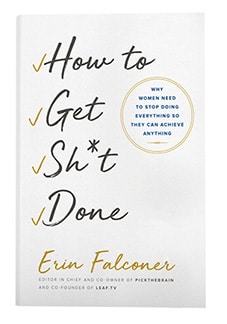
GET THE BOOK BY
ERIN FALCONER!


I am only commenting to make you understand of the notable discovery my wife’s princess enjoyed viewing your webblog. ラブドール販売
00
Hi! My daugther and I are moving into a new apartment and plan to renovate it, but I do not know where best to go with this issue, maybe you can help me ? I just don’t know much about it and would appreciate any help)
Repairs are a pretty tough job, especially when you first come across it. I was once confused and didn’t know what to do, but my dad advised me the good folks at Home Remodeling westwood , https://ubrothersconstruction.com/l-home-renovation-westwood their website. After turning to them for help, we made a very good repair in the house. I even kept the pictures (we now live somewhere else).
에볼루션코리아
962WXXnwS{[*
에볼루션카지노
782VlQANJ$-)
에볼루션바카라
930CmqePO-;%
에볼루션룰렛
736edErif&(\
에볼루션블랙잭424djlldX[^#
The best e-cigarette liquid site in Korea. Korea’s lowest-priced 전자담배 액상 사이트 e-cigarette liquid.
스모크밤869 스모크밤
에볼루션카지노
257TBMzpP.<-
에볼루션카지노
807hlqvvz&^?
에볼루션카지노
043uNwKgg^:}