
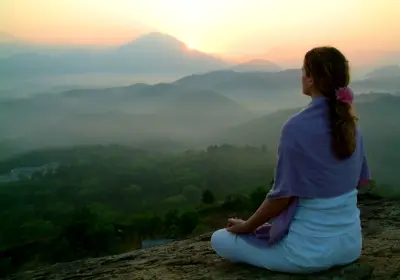
Meditation promotes good health by fighting off the adverse effects of stress – but what is stress anyway?
Stress is the response to a situation that motivates us to perform an action – whether that be fleeing from an attacker, worrying, or just mowing the lawn.
How Your Body Reacts to Stress.
If you become stressed (even mildly) your Sympathetic Nervous System works to cause you to act appropriately. Hormones like adrenaline and others kick in; we get excited or anxious; muscles tighten; blood pressure, heart rate, and breathing rate rises. We use up more energy. This is the “Fight or Flight Response”.
Whether it be a small event or a life-threatening one, our bodies respond to stress in a similar way. The difference is that the level of response adjusts to meet the perceived level of threat.
This system can get out of whack and people may find they are overreacting to some of the smaller stressors of life.
Are You Uptight?
You may be a lot more wound up than you need be. For example: doing something simple like mowing the lawn shouldn’t be all that stressful. But if you were to stop mid-task and take a minute to ask yourself ‘what is my mental state right now?’, you may find you are more stressed-out than you realize. This could be because the mower wouldn’t start immediately, or because you’re dwelling on job-related pressures, or because you are habitually high-strung.
Whatever the case, if you are stressed, you are over-stimulating your body’s sympathetic nervous system.
You Are A Bundle of Nerves
Your body is geared up to react to the signals it receives from the mind. Simply put, when you experience ‘negative’ emotions (fear, irritation, anger, stress, bitterness, etc.) your mind interprets this simply as ‘There is danger here; it is not time to relax. All hell could break loose at any minute, better stay ready for action.’
The human body is wired up to react to danger very quickly. At the first sign of ‘danger’ (which could just be slow traffic driving you nuts) the hypothalamus sends off a myriad of signals which prepare us to respond to the perceived threat. When the hypothalamus sends out these distress signals, our bodies redirect energy from other less immediately vital areas to the functions that are specifically needed to respond to the stress.
Why Stress is Bad for Your Body
When your mind and body are in ‘fight or flight’ mode, your immune system suffers because the body is redirecting energy reserves that the immune system needs to other areas of the body. Therefore the more ‘stressed’ you are at any given moment – the less work your immune system is doing to get rid of all the nasties that are in your system.
When you are highly agitated, the immune system pretty much packs up shop and has a siesta while all the drama unfolds elsewhere. Same goes for your digestive system, which is why you may lose your appetite when stressed.
Hormones also have a starring role in this picture. Adrenaline, noradrenalin and thyroxin are amongst the many hormones that get released into the system to perform their role in the ‘fight-or-flight’ scenario. These hormones have specific jobs, such as speeding up the heart rate, or raising body temperature, or swelling a fresh wound.
While this is all natural and necessary, problems arise when we don’t know how to switch off these responses. The body remains on stand-by for trouble, due to negative patterns of thought (worrying about the future, anger, dwelling on the past, etc.), or even just because we are so busy in general. This means the immune system isn’t getting enough time to do its job – so healing does not take place, or if it does, it is at a reduced rate of efficiency.
Unless you meditate, you typically never give the parasympathetic nervous system a go, but rather you settle into a pattern of swinging between a state of high arousal and one of habitual, low-level tension. Even when you go to bed, your dreams may be full of the day’s stress, and your body is so busy playing catch-up that you never quite get to a more desirable state of balance.
What is the Relaxation Response?
The basic theory behind the effectiveness of meditation is that it helps to take the mind (and thus the body) out of the stressed, ‘fight-or-flight’ mode that humans tend to get stuck in, and into the mode known as the Relaxation Response.
This was recognized by Dr Herbert Benson, a professor of medicine at Harvard Medical School, in 1967, who reportedly sneaked a number of practitioners of meditation into the laboratory to measure what was happening to them biologically when they were meditating.
Benson measured their vital statistics and found that the meditators were using less oxygen, lowering their heart rates, and generating more Theta brainwaves, which are associated with the relaxed state of sleep, or in this case the mental stage just prior to sleep. Dr Benson coined the term the Relaxation Response in his book of the same name and began a process whereby western empirical science began to understand the biological implications of meditation.
In the third post of this three-part series, we’ll look at how meditation strengthens your immune system, how to use meditation to achieve biological balance and what the benefits of this are.
Seamus Anthony is a musician, writer and entrepreneur who lives in the beautiful Dandenong Ranges, near Melbourne, Australia. You can check out more of his personal development writing at http://rebelzen.com
GET THE BOOK BY
ERIN FALCONER!



Yourdollには、あらゆる体型、サイズ、ジャンルの1000以上のリアルなラブドールの素晴らしいコレクションがあります。 wmdoll 163cm
에볼루션코리아
933FFzCzG&+|
에볼루션카지노
400jdhAEN*)@
에볼루션바카라
574MeLSBC]|%
에볼루션룰렛
586hEIkXo`(,
The best e-cigarette liquid site in Korea. Korea’s lowest-priced 전자담배 액상 사이트 e-cigarette liquid.
스모크밤917 스모크밤
전자담배 액상 사이트 The best e-cigarette liquid site in Korea. smok25 Korea’s lowest-priced e-cigarette liquid. 스모크밤847 스모크밤
제주룸
892HalKPA};/
에볼루션카지노
001jvByjE},”
BETMİNA Güvenilir bonus veren siteler başarılar diliyor. betmina giriş